
An Oxfordshire biotech company relies on specialist waste management company Grundon to manage its full spectrum of recycling and reprocessing services.
Its high-tech facilities mean it produces both clinical waste and hazardous waste, as well as more traditional recycling materials such as plastic and cardboard; food waste and confidential shredding.
While Grundon began providing services for the disposal of its hazardous waste in 1998, it has gradually expanded to cover a full remit of recycling and reprocessing services.
Grundon’s Paul McConaghy, Commercial Manager – Hazardous Waste, explains: “Our customer is a great forward-thinking company and it is very much a partnership about how we can do more to support them.”
One of the keys to the successful recycling programme is education and communication. As technology develops, so too does the complexity of the waste streams, making it ever more important to dispose of materials in the correct bins.
Grundon works with the company’s green team and supports it through waste awareness days, campaigns and regular visits, as well as providing materials such as posters for the laboratories so everyone can identify how to dispose of items correctly.
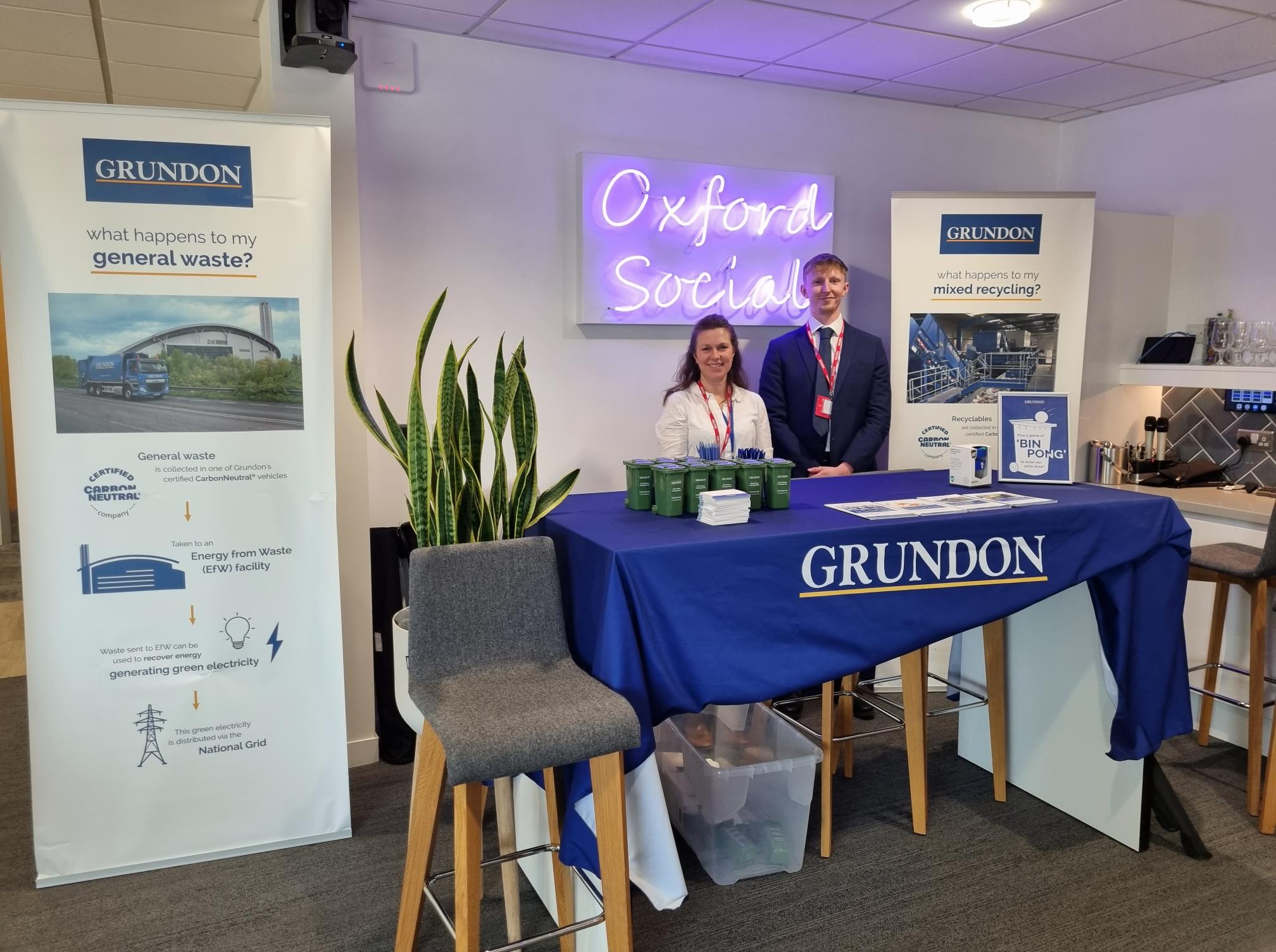
Representatives from Grundon’s dry waste, clinical and hazardous waste teams all attend an annual on-site event to celebrate Earth Day; where activities include hosting a pop-up awareness stand, staff training presentations, playing interactive games, and providing guidance on correct waste segregation.
A spokesperson for the company said:
“Grundon supports us very well. I think good communication is having someone who you can turn to to ask questions and Grundon has been fantastic, there is always someone on the end of the phone to provide the answers we need.”
Waste reporting is also important and Grundon supplies the customer with all the necessary data and statistics to support its external auditing requirements.
Clinical waste
The company spokesperson continues:
“We use a lot of consumables, some that don’t fit into general waste or mainstream recycling. Everyone is very keen to find the right solution and that’s where Grundon helps us.”
Louise Coles, from Grundon’s Clinical Waste team says: “Lab plastics are one of the biggest challenges and it’s an area we are really concentrating on, working with the company to find right specialist treatment and processing options.”
With laboratory space at a premium, Grundon supplies clinical 30 litre Bio-bins. These provide a sustainable and space-saving way of managing small amounts of clinical waste, which is then sent for incineration.
A recent success story has been the segregation of offensive waste within all on-site labs. Following a series of clinical audits, materials that are classed as offensive, non-infectious waste are now disposed of in separate bins and sent to Grundon’s Energy from Waste (EfW) facility.

To support the changeover, Grundon provided bespoke educational materials, including tailored posters, for the in-house teams.
In the first seven months of the new system, over 1,700kg of offensive waste was segregated and sent for incineration at EfW facilities, a solution that is both more cost-effective than High Temperature Incineration (HTI) and generates significant carbon savings.
On average, over 10% of the customer’s clinical waste is now treated via EfW, and between June – December 2025, this generated over 9,558kWh of power for the National Grid. Grundon will continue to support the expansion of the offensive waste stream through ongoing pre-acceptance audits which ensure fully compliant waste segregation.
Contaminated and infectious clinical waste continues to be treated by HTI.
Hazardous waste
Typical hazardous waste includes redundant lab chemicals, WEEE (Waste Electrical and Electronic Equipment), liquids and solvents.
Given the large amount of liquids and solvents on site, a Grundon ChemPack chemist visits weekly to bulk up the materials into drums, ensuring the process is managed both safely and in compliance with all necessary legislation.

Paul McConaghy explains: “For example, a lot of solvents are generated and originally, we were collecting these in drums and sending both the liquid and the drums for disposal.
“In talking to the customer, we realised it could be done more cost effectively by sending in our ChemPack chemist to manage the bulking up on site instead – this saves money overall and is also more sustainable because they can reuse their drums rather than having to purchase new ones each time.”
Paul McConaghy
Commercial Manager - Hazardous Waste
Other items, including pharmaceutical-related materials, acids and base waste, and lab smalls; are also packaged up ready to be collected.
Items such as aerosols, cleaning chemicals, electrical equipment and batteries, which are classed as hazardous waste within the workplace, go into a Grundon Haz-Box installed within the laboratories. The 55-litre container is small enough to fit under a counter and is usually collected quarterly.

For bigger items, a WEEE cage and a 12-yard Rear End Loader (REL) act as on-site collection points for specialist materials.
When sufficient quantities are in place, the materials are taken to Grundon’s dedicated Hazardous Waste Transfer Station at Ewelme in Oxfordshire, where its experts ensure these difficult waste streams are sent up the waste hierarchy for recycling, reprocessing or reuse.
Mixed recycling
Thanks to Grundon’s expertise, the organisation was already prepared for the new Simpler Recycling legislation, introduced in March 2025, which determined that all businesses must have a collection for dry recyclable materials (plastic, paper and card, glass, metals) and separate food waste from general waste.
The successful partnership consistently achieves dry mixed monthly recycling rates of over 60%, surpassing 70% on several occasions.
In 2025, Grundon’s waste and recycling expertise ensured the facility saved 27,822 of CO2 – equivalent to saving 232 trees – and generated over 7,500kWh of power.
Materials are taken to Grundon’s Materials Recovery Facility (MRF) for sorting and recycling, while non-recyclables go to its EfW operation, which generates electricity for the National Grid.
Food waste is segregated and sent for Anaerobic Digestion where it is processed into bio-fertiliser used by UK farmers, while confidential paper waste is collected and sent for shredding.
Carbon savings are also boosted by Grundon’s CarbonNeutral®-certified vehicles, meaning its collections do not add to its clients’ carbon footprint.